
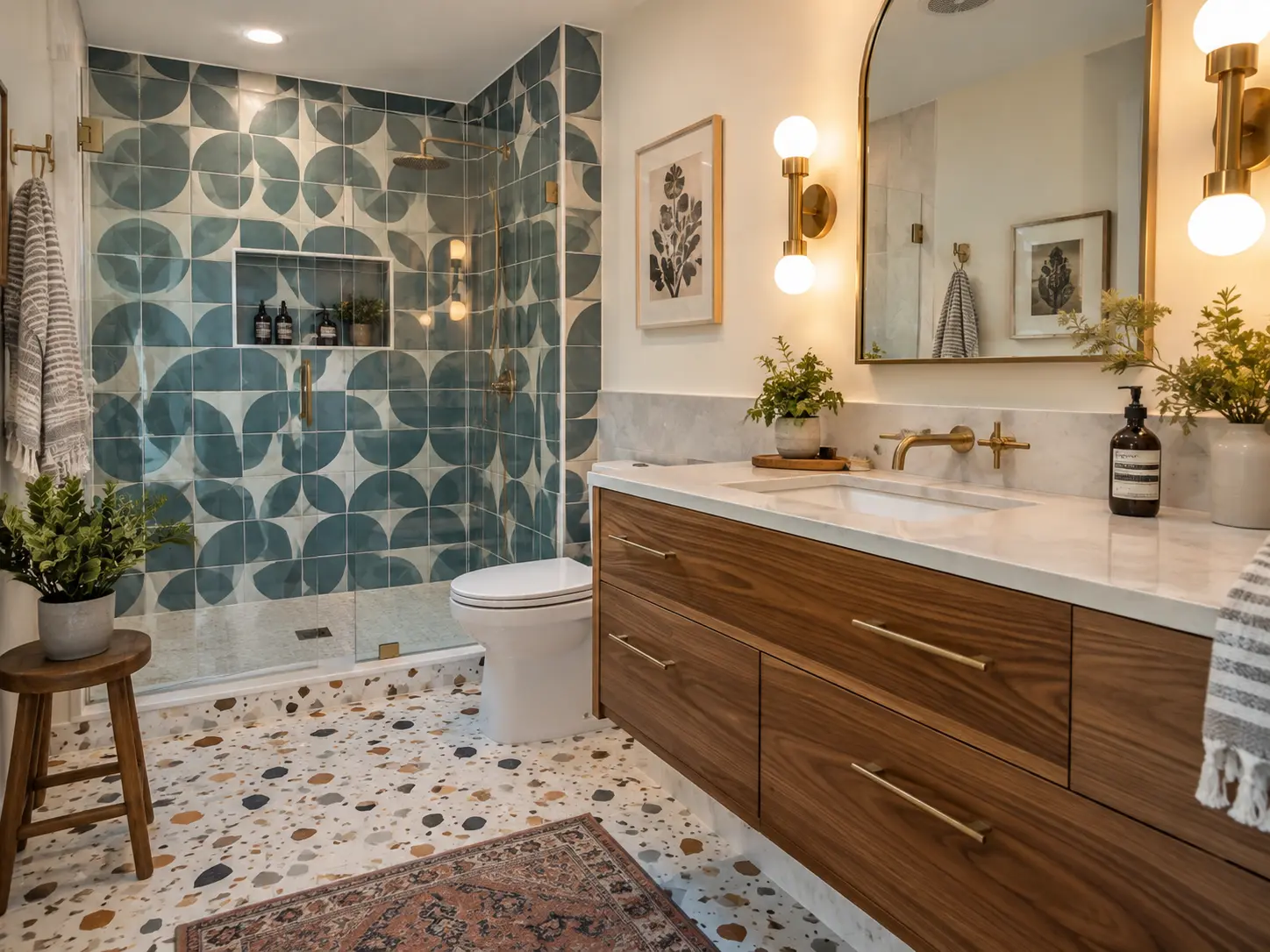
Material choices
Porcelain
Dense, very low absorption and available in convincing marble, limestone, terrazzo and wood looks. It is the workhorse of South Florida bathrooms and the default recommendation for shower walls and floors.
Ceramic
Lighter and generally less expensive, well suited to wall applications. Less appropriate for floors that see heavy use.
Natural stone
Marble, travertine and limestone offer depth that printed surfaces cannot match, at the cost of ongoing sealing and susceptibility to etching from acidic products. Beautiful in a primary bathroom for owners who accept the maintenance.
Glass and specialty mosaics
Excellent as a feature: a niche back, a single accent band, or a shower floor. Used across a whole room they become visually loud and labor-intensive.
Format, slip resistance and layout
- Large-format tile reduces grout lines and makes small rooms read calmer, but needs a flat substrate
- Shower floors need traction: smaller tile with more grout joints, or a textured porcelain rated for wet areas
- A center drain requires a four-way slope, which favors smaller tile; a linear drain allows a single plane and large tile
- Vertical stack and vertical running bond emphasize height; horizontal layouts widen a room
- Herringbone, chevron and mitered outside corners look superb and add labor time
- Plan cuts so full tiles land at eye level and symmetrical cuts land in corners
Grout and movement joints
Grout is a finish, not a waterproofing layer. High-performance cement grouts resist staining well and are the common choice; epoxy grout offers the highest stain and chemical resistance at higher installation cost and difficulty. Color matters too — a grout close to the tile color hides layout variation, while a contrasting grout makes the pattern the feature.
Every change of plane should be filled with a flexible sealant rather than rigid grout: inside corners, the junction where walls meet the shower base, the top of a curb, and where tile meets a tub or countertop. These joints move slightly with temperature and structure, and rigid grout in them cracks.
Ordering, lead times and overage
Order all tile for a room at once from the same production run so that shade and caliber match. Add overage for cuts and future repairs — roughly ten percent for a straight layout and fifteen percent or more for diagonal or herringbone patterns. Keeping a small quantity after the project is finished is worthwhile; matching a discontinued tile years later is often impossible.
Lead time is the scheduling risk. Specialty and imported tile can take weeks. Confirming availability before demolition is one of the simplest ways to keep a project moving.